
Stumbling in the Dark
The similarity between death's oblivion and life's uncertainty
Into the Earth
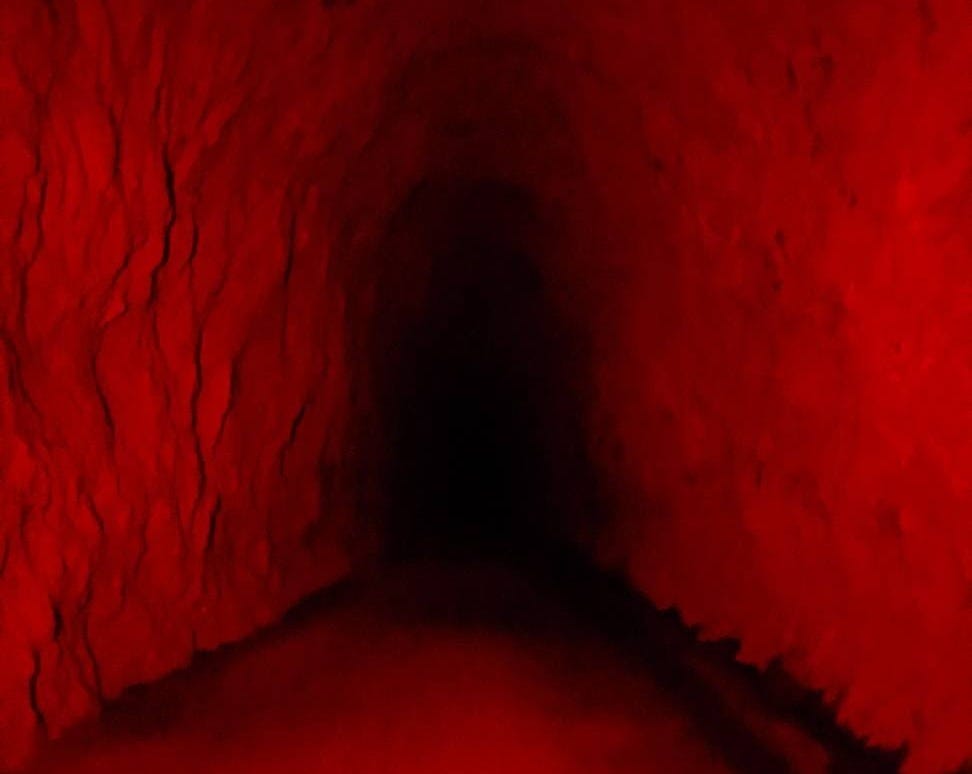
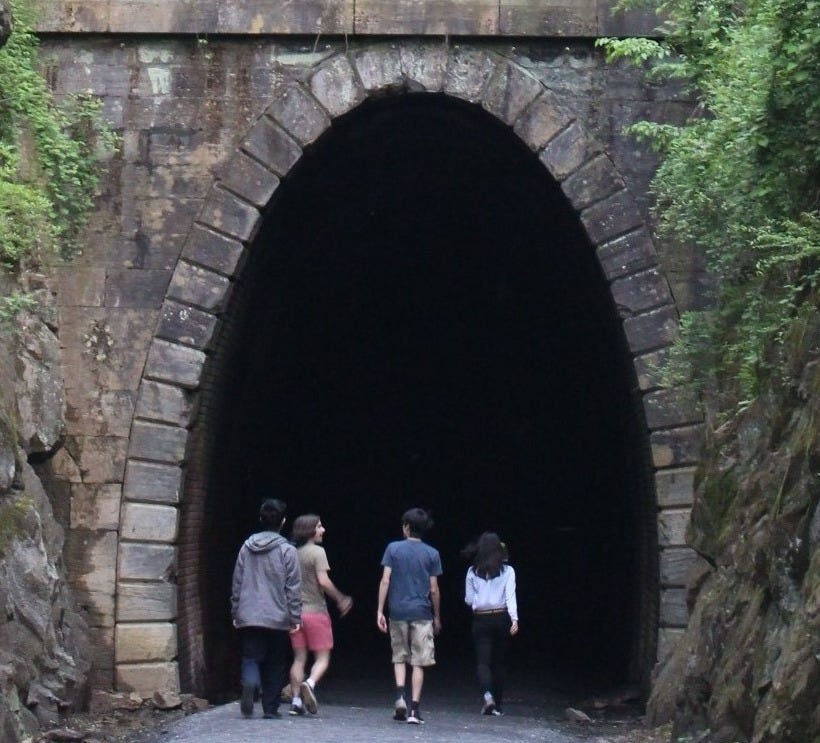
During my senior year in college, I drove over the mountains for a ten-minute doctor’s appointment. Despite the dreadful ratio of two hours to ten minutes, the trip turned out to be more than worth my while. Just beside the road, I caught sight of a sign advertising “The Blue Ridge Tunnel.” In a surprising turn of events, I managed to wait until after my appointment to interrupt my return trip to go explore this intriguing feature. There, under a great stone archway at the base of a wooded slope, the railway-turned-hiking trail beckoned me in. A white pinprick at the end of the tunnel gave the only real light. I quickly decided to try something a little different to the other tourists’ phone flashlights, leaving mine off and moving through the tunnel only looking forward to that one light, more as an experiment than anything profound.
Water dripped or sometimes streamed down the walls, echoing better off the blasted stone than the brick briefly holding up the tunnel where I’d entered. Despite the Park Service’s best efforts (and due to foot traffic, at least partly) the path was almost as uneven as a dirt road after the snow melts. Every few steps, with only the eye of a needle in the dark, I stumbled.
I couldn’t tell in the dark how close the walls were. Neither could I see where exactly to place my foot. The strange experience invigorated me, and my energy swelled. I began to sprint. Exchanging uncertainty for risk, I ran through the tunnel that seemed wide as space, though darker.
A month later I brought four friends back to the tunnel for an excursion. Along the way, one of them managed to play his guitar from his huddle in the middle seat, thought the feat was diminished by the fact we barely knew any of the same songs between us. While walking from the car down a switchback to the tunnel, we resorted to spontaneous melody with improvised harmonies. The singing continued in the tunnel, which generously amplified it. Unlike my previous visit in the early afternoon, we arrived on a cloudy day shortly before dusk, so there was no light at the end of the tunnel until we were practically through it. Partly as a result, and partly because I had friends with a flashlight, the tunnel seemed less eerie this time. The light had given contrast. This time, I had nothing visible to set against the hidden, or direction against apparent emptiness.
After we doubled back from the other end, the quietest of our little crew sped up to walk ahead of the rest of us, without rancor but with clear intent. I waited until we reached the archway to quicken my own step and catch up.
“What did you think?” I asked.
“Oh, I was being a little angsty. I wanted to imagine what it will be like to be dead.”
A Dim Mirror
Humans have held off the dark for ages. Today, we find it easier than ever with our electricity and devices. We often exchange blue skies for blue light (though I digress). A delightful image of darkness, illumination, and respite comes from the court of King Edwin, as recounted by the Venerable Bede:
The present life of man upon earth, O King, seems to me in comparison with that time which is unknown to us like the swift flight of a sparrow through the mead-hall where you sit at supper in winter, with your Ealdormen and thanes, while the fire blazes in the midst and the hall is warmed, but the wintry storms of rain or snow are raging abroad. The sparrow, flying in at one door and immediately out at another, whilst he is within, is safe from the wintry tempest, but after a short space of fair weather, he immediately vanishes out of your sight, passing from winter to winter again. So this life of man appears for a little while, but of what is to follow or what went before we know nothing at all.1
For my friend, the Blue Ridge Tunnel recalled such old associations with the dark: the vast unknown, and death.
My mind ran in another direction, however. Space came to mind during my sprint, an association reinforced on the second trip when I sang with my friends like “the music of the spheres” in the void. I thought of Milton and God’s “dark materials” readying for worlds as yet unmade.
Unlike my friend who imagined death, stumbling in the dark seems to me more like an image for life. Where is the light switch? Can I find the door? Bloody hell… (I kicked the wall.) Footing and movement are all too rarely certain, but still we move by the help of any vague light we receive, our sense of touch, and, if we’re fortunate, a sixth sense of direction. Once we reach the light we find hindsight’s clarity, even if a simple room seems a world transformed. When I sprinted through the tunnel I was always navigating a firm world, despite the darkness’ vacuum suggesting endless possibility. My own tenuous grip on the geography reminds me of the decision process on all levels, from where to eat to careers and relationships.
Though the darkness denied the perfect awareness my senses typically pretend, even these heightened and led me safely through on my first trip. The second trip through the tunnel was significantly more grounded, much thanks to the presence of my friends. Simply moving together steadied our steps (admittedly, it may have helped that this time I wasn’t sprinting through pitch black without a flashlight), and we had plenty of occupation between chats and music. In the dark, the vague world seemed clearer, or at least a little less abstractly threatening. Like our walks of life, nighttime walks are better when you have someone along.
There's a light out in the dark
So take my hand
I learned to stand
You learned to fall harder
So take my hand
I'll take you much farther
There's a light out in the dark
So take my hand2
The Venerable Bede, The Ecclesial History of the English People, Book II Chapter 13.